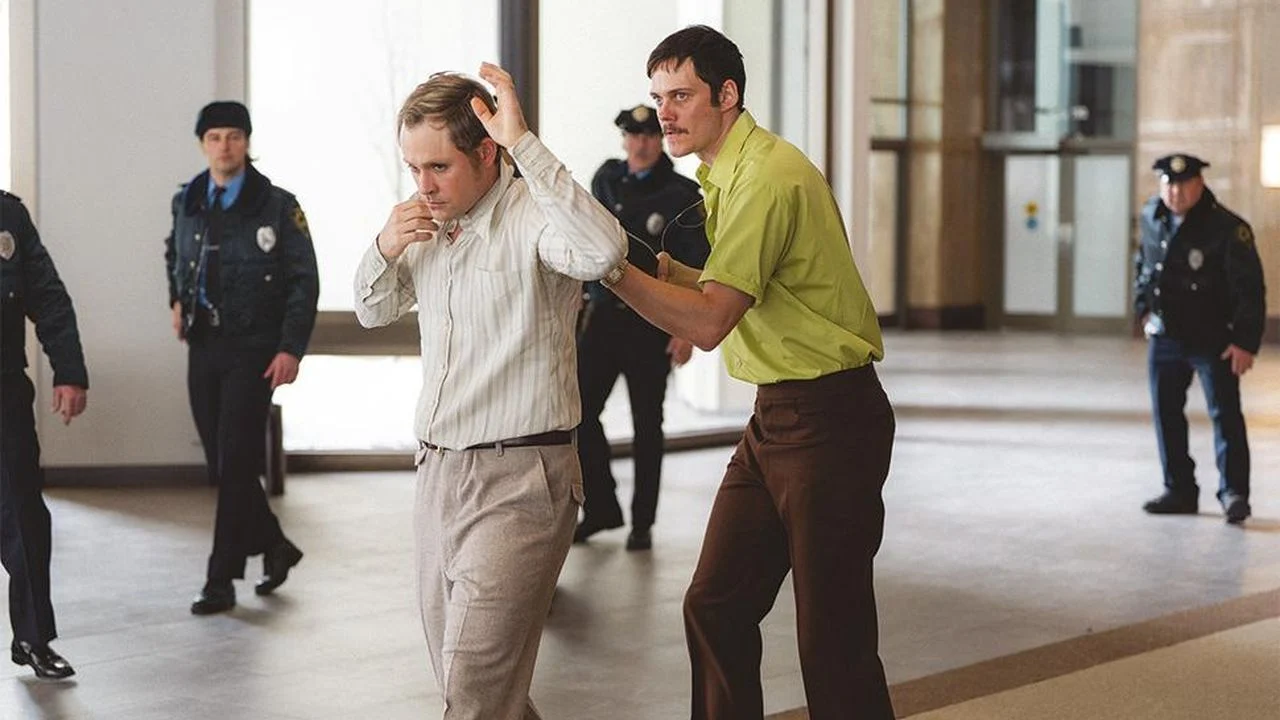
On the morning of February 8, 1977, Tony Kiritsis walked into a mortgage office in Indianapolis convinced the system had finally turned on him. What followed was one of the most unsettling media spectacles of the decade: a 63-hour hostage standoff in which Kiritsis literally wired a sawed-off shotgun to both his victim’s neck and his own chest. It was desperation theater, broadcast live, raw and ugly, and fueled by a man who believed grievance was the same thing as righteousness.
That’s the true story. “Dead Man’s Wire”, as directed by Gus Van Sant, tells a different one.
Van Sant approaches the material not with moral gravity but with a sly, knowing smirk, presenting the ordeal as a swaggering crime comedy steeped in thick, sometimes suffocating, seventies nostalgia. Bill Skarsgård plays Kiritsis less as a volatile extremist than as a rumpled folk anti-hero—dangerous, yes, but also oddly charming. The film leans hard into that contradiction, finding humor in his incompetence (his repeated failure to work a stolen police radio becomes a running gag) while sanding down the more incoherent, disturbing elements of the real man’s televised rants. What remains is just enough populist anger to prop up a half-formed Robin Hood myth without interrogating it too closely.
The movie’s sympathies aren’t subtle. When the head of Meridian Mortgage enters the story—portrayed by Al Pacino as a sun-soaked avatar of corporate indulgence, pettily enraged over a burrito cut the wrong way—the film tips its hand completely. The opening credits cue “The Revolution Will Not Be Televised,” deployed with heavy irony after Kiritsis’ stunt interrupts a national broadcast. Van Sant and Skarsgård clearly see this as a little-guy uprising, even if that framing grows increasingly uncomfortable the longer it lingers.
That discomfort is the film’s central problem. In an era still reckoning with how grievance curdles into violence, “Dead Man’s Wire” feels curiously cavalier about where outrage ends and accountability should begin. Yet the film remains watchable—often entertaining—on a surface level. Skarsgård commits fully, Pacino makes the most of his limited screen time with delicious sleaze, and Colman Domingo brings warmth and authority as the radio host who becomes the story’s unofficial narrator.
Technically, the film is immaculate in its period detail, from cluttered offices to analog broadcast studios to policing that feels improvisational rather than procedural. There’s a queasy humor in watching Kiritsis stroll unchallenged through lines of stunned officers, his homemade contraption holding the entire city hostage.
You can admire the craft, laugh at the audacity, and still feel a knot in your stomach. Dead Man’s Wire could have been many things. As a feel-good crime comedy, it mostly works. Whether it should have tried so hard to be one is another question entirely.
Final Grade : B
“Dead Man’s Wire” is in limited release now and goes wide on January 9th, 2026