As the Oscar Season heats up, I wanted to highlight “Sirât”, Spain’s submission for this year’s Academy Awards. Neon will expand the film out for wide release next month. The film is directed by Oliver Laxe who co-writes the script with Santiago Fillol.
The duo turns the desert road movie into something closer to a spiritual stress test. The title refers to the Sirât bridge— “thin as a hair, sharp as a knife”—and that image hangs over every mile traveled, every choice made, every engine pushed forward into uncertainty. This is not a journey designed for comfort. It’s a film that asks what happens when belief, fear, and survival collide far from any moral guardrails.
The opening sequence sets the tone with a jolt. A massive rave erupts against a towering rock face in the Moroccan desert, bodies moving in unison as basslines pound the air into submission. Laxe focuses on the mechanics of ritual: cords jammed into amplifiers, switches flipped, speakers trembling. The repetition becomes hypnotic. Music stops being entertainment and starts functioning like prayer. Civilization feels distant, irrelevant, already abandoned.
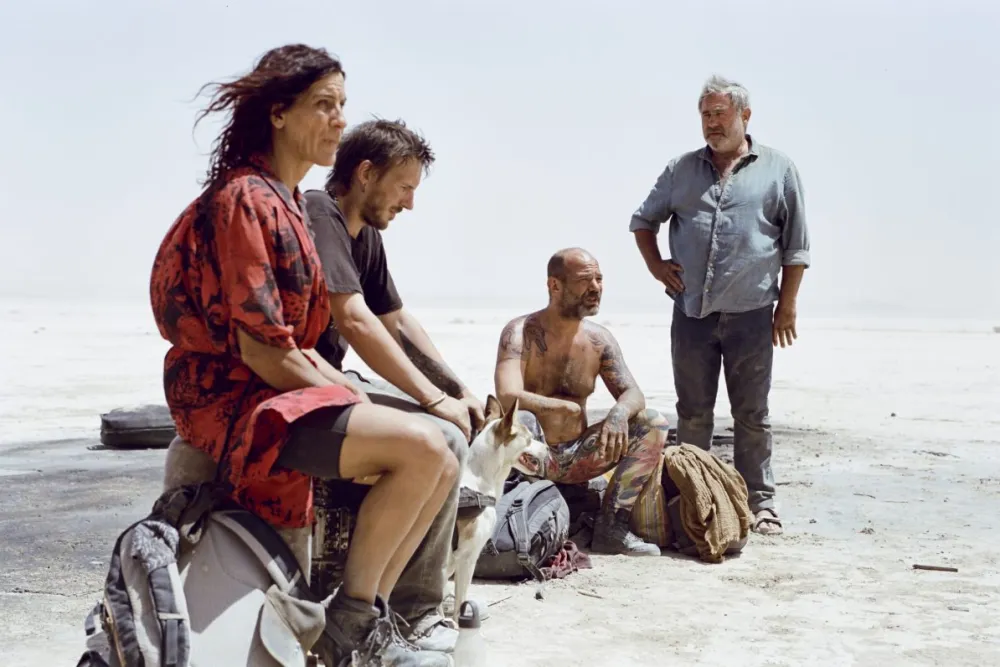
Out of that chaos rolls a convoy of heavy trucks pushing deeper into the desert, joined by an unexpected outlier—a silver family van. Inside is Luis (Sergi López), a father searching for his missing teenage daughter, who has disappeared into this drifting, drug-hazed community. He brings along his young son, a quiet witness to everything that follows. The contrast is immediate and unsettling. Luis doesn’t belong here, and neither does his idea of order. His presence disrupts the rhythm, injecting urgency into a group that seems content to drift until the world ends.
Laxe fills the convoy with faces that feel lived-in rather than performed. These aren’t characters designed for easy identification or redemption. They are bodies in motion, scarred, altered, and committed to movement over meaning. The film resists exposition. Information arrives through terrain, exhaustion, and sound design. The desert isn’t a backdrop—it’s an active force, stripping away certainty with every mile.
As the journey stretches on, the film begins to feel like a slow descent rather than a forward push. The trucks race across open plains, then creep along narrow passes where one mistake means obliteration. Every turn feels final. There’s no sense of recalculation, only momentum. The further they go, the clearer it becomes that turning back was never an option.
By the time the outside world intrudes—war no longer implied but undeniable—Sirât has shed any illusion of escape. What remains is a bleak meditation on displacement, survival, and the fragile stories people tell themselves to keep moving. Laxe doesn’t offer resolution or relief. He leaves us staring into the dust, asking whether crossing the bridge was an act of faith—or simply the last mistake.
Final Grade: B+
“Sirât” opens in theaters next month.