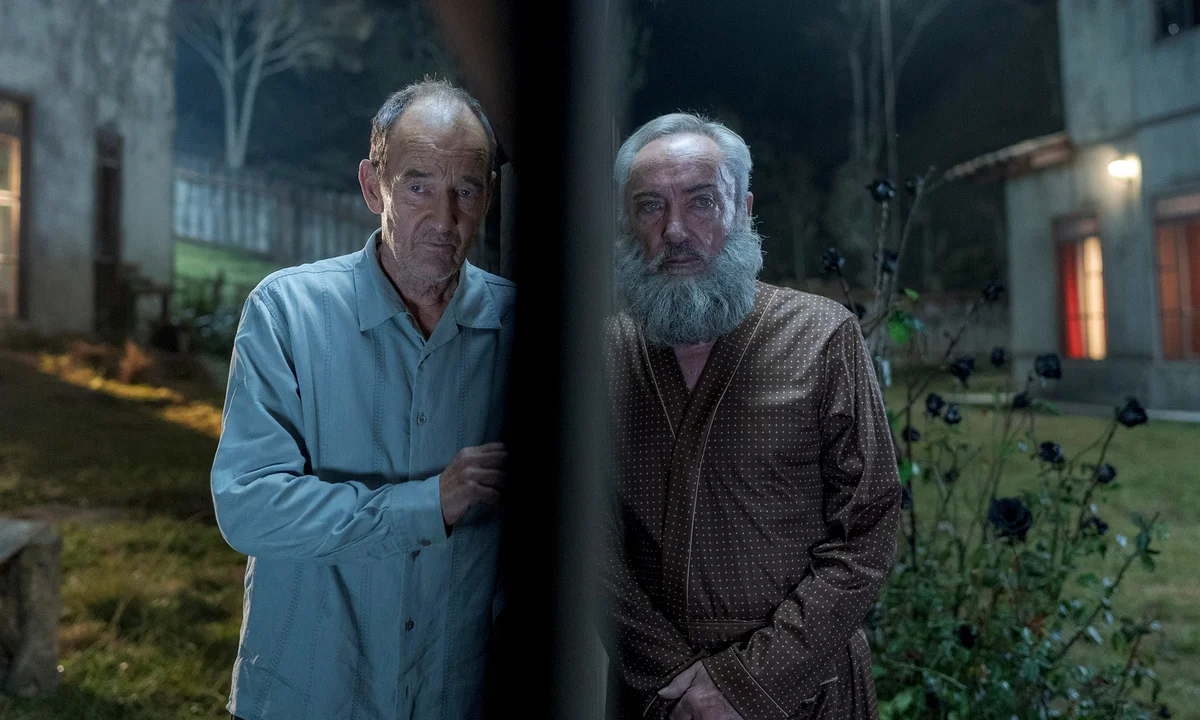
Director Leon Prudovsky’s latest film, My Neighbor Adolf, from Cohen Media Group, arrives with a premise that demands precision: set in Colombia shortly after Israel’s capture of Adolf Eichmann in 1960, the film centers on Mr. Polsky (David Hayman), a cantankerous Polish Holocaust survivor living in isolated rural exile. He tends his rose garden, plays solitary chess, and carries the weight of unspeakable loss.
When a stern, German-speaking older man, Mr. Herzog (Udo Kier), buys the neighboring property, Polsky becomes convinced the newcomer is Adolf Hitler in hiding. Dismissed by authorities and locals, Polsky launches his own investigation, forcing him into reluctant proximity with the very man he suspects of ultimate evil.
This is the sort of high-wire concept that could collapse into tasteless farce or maudlin sentimentality in lesser hands. Prudovsky, co-writing with Dmitry Malinsky, avoids both traps through restraint and a refusal to overexplain. The film never outright confirms or denies Polsky’s suspicion, letting ambiguity fuel tension rather than cheap revelation. What emerges instead is a study of loneliness, paranoia, and the fragile boundaries between enmity and connection.
David Hayman delivers a career-best turn as Polsky. His performance is all coiled anger and quiet devastation—eyes that dart with suspicion, a voice roughened by decades of grief. Hayman makes the character’s stubbornness believable without turning him into a caricature; each outburst feels justified from a man who has already lost everything once. In contrast, the late Udo Kier adds a sense of understated menace and unexpected vulnerability to Mr. Herzog, the neighbor.
With Kier’s passing in November 2025 at age 81, this role now carries an added poignancy—one more indelible entry in a career spanning over 200 films, from cult horrors to arthouse masterpieces. His subtle choices here—a precise gesture, a fleeting softness when discussing roses—keep the character human without ever softening the historical horror his presence evokes. Kier’s singular presence, blending menace with humanity, will be profoundly missed in cinema.
The scenes featuring the characters together, especially the chess matches that turn into a reluctant ritual, have a genuine emotional depth. Radek Ladczuk’s cinematography contrasts the vibrant Colombian landscape with the characters’ internal emptiness, while Hervé Schneid’s editing keeps a careful pace that allows the feeling of unease to develop naturally.
“My Neighbor Adolf” ultimately asks difficult questions about recognition of evil, the persistence of trauma, and whether proximity can breed understanding without forgiveness. It doesn’t provide easy answers, and that’s its strength.
In an era of loud historical dramas, Prudovsky’s film opts for quiet power. Hayman and Kier’s work alone makes it essential viewing—a small, brave movie that lingers long after the credits.
Final Grade: B
“My Neighbor Adolf” opens in limited theaters today.