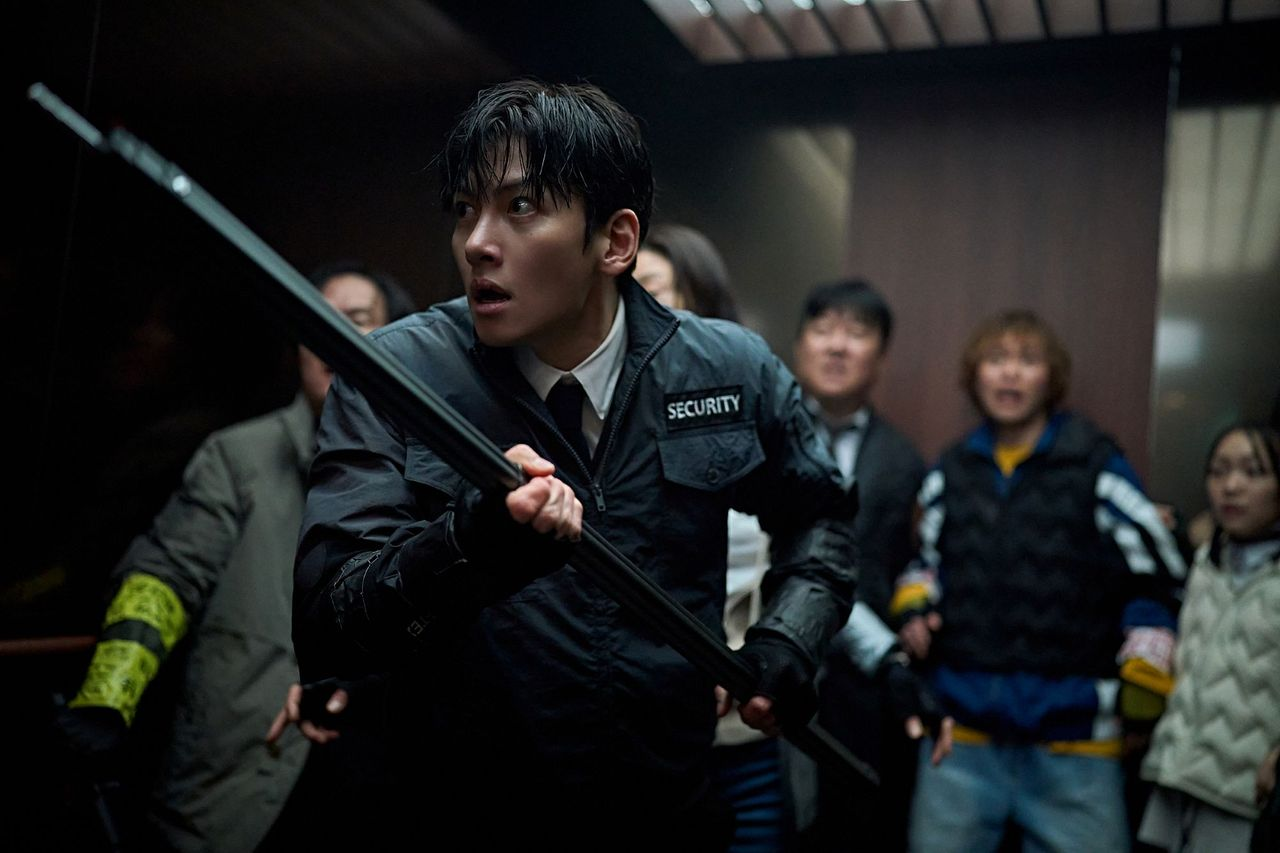
Horror director Yeon Sang-ho returns to the world of Korean zombies with his latest film, “Colony”, released by Well Go USA. Co-writing the screenplay with Choi Gyu-seok, Yeon explores familiar genre territory while avoiding the typical outbreak formula. Instead, “Colony” introduces an intriguing twist to the infected mythology and delivers the intense, blood-soaked spectacle audiences expect from the filmmaker.
The story centers on Professor Se-jeong, played by Jun Ji-hyun, who finds herself trapped inside a biotech conference after a rapidly mutating virus is deliberately unleashed, leading authorities to seal off the facility. With escape seeming impossible, Se-jeong and a small group of survivors must navigate an increasingly perilous environment as the infected begin to change in unexpected ways.
This evolution becomes the film’s strongest aspect. The individuals infected are not merely content to sprint, bite, and overwhelm their victims. As the outbreak progresses, they learn from one another, coordinating their movements and developing what appears to be a form of collective intelligence.
This concept gives “Colony” fresh energy compared to typical undead thrillers, as survival is no longer just about outrunning the threat; the characters must adapt to an enemy evolving alongside them. Yeon effectively utilizes the confined setting to his advantage. Hallways, stairwells, and crowded rooms become increasingly treacherous as the infected attack in waves, allowing the director to stage several impressively chaotic sequences while maintaining spatial clarity.
The film is packed with gore, and Yeon does not shy away from depicting twisted bodies and sudden bursts of violence. Nevertheless, the action is crafted skillfully enough to keep the carnage from becoming monotonous.
Jun Ji-hyun delivers a compelling performance as Se-jeong. Rather than portraying her as an immediate action hero, she emphasizes the character’s intelligence, composure, and evolving survival instincts. Koo Kyo-hwan takes a more unpredictable approach as scientist Seo Young-cheol, providing an unsettling presence whose decisions ripple throughout the story.
However, the screenplay leaves some intriguing ideas underdeveloped. Questions about scientific responsibility, collective behavior, and whether the infected retain enough humanity to deserve salvation are raised but not fully explored. Additionally, a few supporting characters could benefit from greater depth, especially since the film asks audiences to care about their eventual fates.
Despite these shortcomings, they rarely diminish the film’s momentum. Yeon knows precisely when to tighten the tension, unleash the infected, and remind audiences why Korean genre cinema has produced some of the most memorable zombie storytelling in modern times.
“Colony” may not completely reinvent the outbreak thriller, but by allowing its monsters to evolve, Yeon Sang-ho breathes new life into familiar material, making the experience worthwhile.
Final Grade: B
“Colony” opens in theaters today.