Director Dave Green continues to carve out a comfortable niche for himself in family-friendly entertainment with his third feature, “Coyote vs. Acme”, from Ketchup Entertainment. Samy Burch pens the screenplay from a story she crafted alongside James Gunn and Jeremy Slater.
Bringing animation and live action together is always a risky proposition, particularly when the characters involved are as iconic as the Looney Tunes. Thankfully, Green understands that the key is not to modernize Wile E. Coyote beyond recognition, but to preserve the absurd determination that has made him funny for generations.
The film draws on Ian Frazier’s 1990 New Yorker article “Coyote v. Acme,” which imagines Wile E. taking legal action against the ACME Corporation over the countless defective products that have failed him in his never-ending pursuit of the Road Runner.
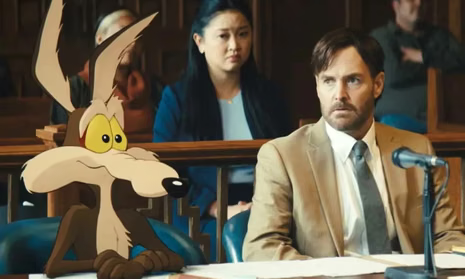
Wile E. turns to Kevin, a struggling Albuquerque attorney played by Will Forte, to take on the case. Standing across from them is Buddy, ACME’s smug in-house counsel, played with broad confidence by John Cena. That setup gives Green room to blend courtroom comedy with the physical mayhem audiences expect, and the film is at its best when those two modes collide.
Forte proves especially valuable because he never tries to out-cartoon the cartoons. His worn-down, understated delivery gives Wile E. space to remain the comic engine, while Cena leans into Buddy’s arrogance with the kind of straight-faced absurdity that suits him well. Both actors understand that the funniest choice is often to treat the impossible as completely normal.
The visual effects also do a great deal of heavy lifting. Wile E. feels convincingly present in the live-action world, and Green stages his interactions with the human cast without drawing unnecessary attention to the technical mechanics. Just as important, the film shows genuine affection for Looney Tunes history without becoming trapped by nostalgia.
Familiar characters, visual callbacks, and slapstick beats are folded into the story rather than displayed like museum pieces.
The screenplay does occasionally overcomplicate what is, at heart, a beautifully simple premise. Once the lawsuit expands into a broader investigation of ACME, some of the corporate satire loses its bite, and a few stretches spend more time with the human characters than the Looney Tunes personalities we came to see.
Still, the movie lands because it understands Wile E. Coyote. His comedy has always been rooted in failure, persistence, and the certainty that one more ridiculous plan might finally work. Turning that stubborn optimism into the emotional spine of a legal comedy is smarter than it sounds.
After decades of explosions, cliffs, and defective gadgets, Wile E. finally gets to fight ACME on his own terms. Coyote vs. Acme may no
Director Dave Green continues to carve out a comfortable niche for himself in family-friendly entertainment with his third feature, “Coyote vs. Acme”, from Ketchup Entertainment. Samy Burch pens the screenplay from a story she crafted alongside James Gunn and Jeremy Slater.
Bringing animation and live action together is always a risky proposition, particularly when the characters involved are as iconic as the Looney Tunes. Thankfully, Green understands that the key is not to modernize Wile E. Coyote beyond recognition, but to preserve the absurd determination that has made him funny for generations.
The film draws on Ian Frazier’s 1990 New Yorker article “Coyote v. Acme,” which imagines Wile E. taking legal action against the ACME Corporation over the countless defective products that have failed him in his never-ending pursuit of the Road Runner.
Wile E. turns to Kevin, a struggling Albuquerque attorney played by Will Forte, to take on the case. Standing across from them is Buddy, ACME’s smug in-house counsel, played with broad confidence by John Cena. That setup gives Green room to blend courtroom comedy with the physical mayhem audiences expect, and the film is at its best when those two modes collide.
Forte proves especially valuable because he never tries to out-cartoon the cartoons. His worn-down, understated delivery gives Wile E. space to remain the comic engine, while Cena leans into Buddy’s arrogance with the kind of straight-faced absurdity that suits him well. Both actors understand that the funniest choice is often to treat the impossible as completely normal.
The visual effects also do a great deal of heavy lifting. Wile E. feels convincingly present in the live-action world, and Green stages his interactions with the human cast without drawing unnecessary attention to the technical mechanics. Just as important, the film shows genuine affection for Looney Tunes history without becoming trapped by nostalgia.
Familiar characters, visual callbacks, and slapstick beats are folded into the story rather than displayed like museum pieces.
The screenplay does occasionally overcomplicate what is, at heart, a beautifully simple premise. Once the lawsuit expands into a broader investigation of ACME, some of the corporate satire loses its bite, and a few stretches spend more time with the human characters than the Looney Tunes personalities we came to see.
Still, the movie lands because it understands Wile E. Coyote. His comedy has always been rooted in failure, persistence, and the certainty that one more ridiculous plan might finally work. Turning that stubborn optimism into the emotional spine of a legal comedy is smarter than it sounds.
After decades of explosions, cliffs, and defective gadgets, Wile E. finally gets to fight ACME on his own terms. Coyote vs. Acme may not reinvent the Looney Tunes formula, but it respects it, plays with it, and finds enough fresh laughs to justify the long-awaited day in court.
Final Grade: B+
“Coyote vs. Acme” opens in theaters tomorrow.
t reinvent the Looney Tunes formula, but it respects it, plays with it, and finds enough fresh laughs to justify the long-awaited day in court.
Final Grade: B+
“Coyote vs. Acme” opens in theaters tomorrow.