There’s a sense of ambition permeating “Desert Warrior”, evident from the very first frame. With Saudi Arabia aiming to transition from oil dependency to becoming a player in global filmmaking, this $150 million epic—directed by Rupert Wyatt and featuring Anthony Mackie—carries high expectations and the promise of grandeur. Unfortunately, what it delivers is a film that struggles before it ultimately finds its stride.
Set in seventh-century Arabia, the story centers on Princess Hind (Aiysha Hart), who resists being handed over as a concubine to the ruthless Emperor Kisra (Ben Kingsley). As she flees into the desert with her father, she unwittingly becomes the focal point of a resistance, pursued by a mercenary with a penchant for chaos (Sharlto Copley). Along the way, she encounters a nameless bandit, portrayed by Mackie—part antihero, part afterthought—whose role in the narrative feels as uncertain as the film’s identity.
This uncertainty is a central issue. For extended periods, *Desert Warrior* feels like two separate films vying for dominance: one focused on Mackie’s solitary drifter and the other on Hind’s journey as a unifier of different tribes. The result is a disjointed narrative that stumbles rather than flows. Scenes emerge, make their point, and then dissipate like sand in the wind. There is a noticeable reluctance in the storytelling, as if the film is still determining which character’s journey is most significant.
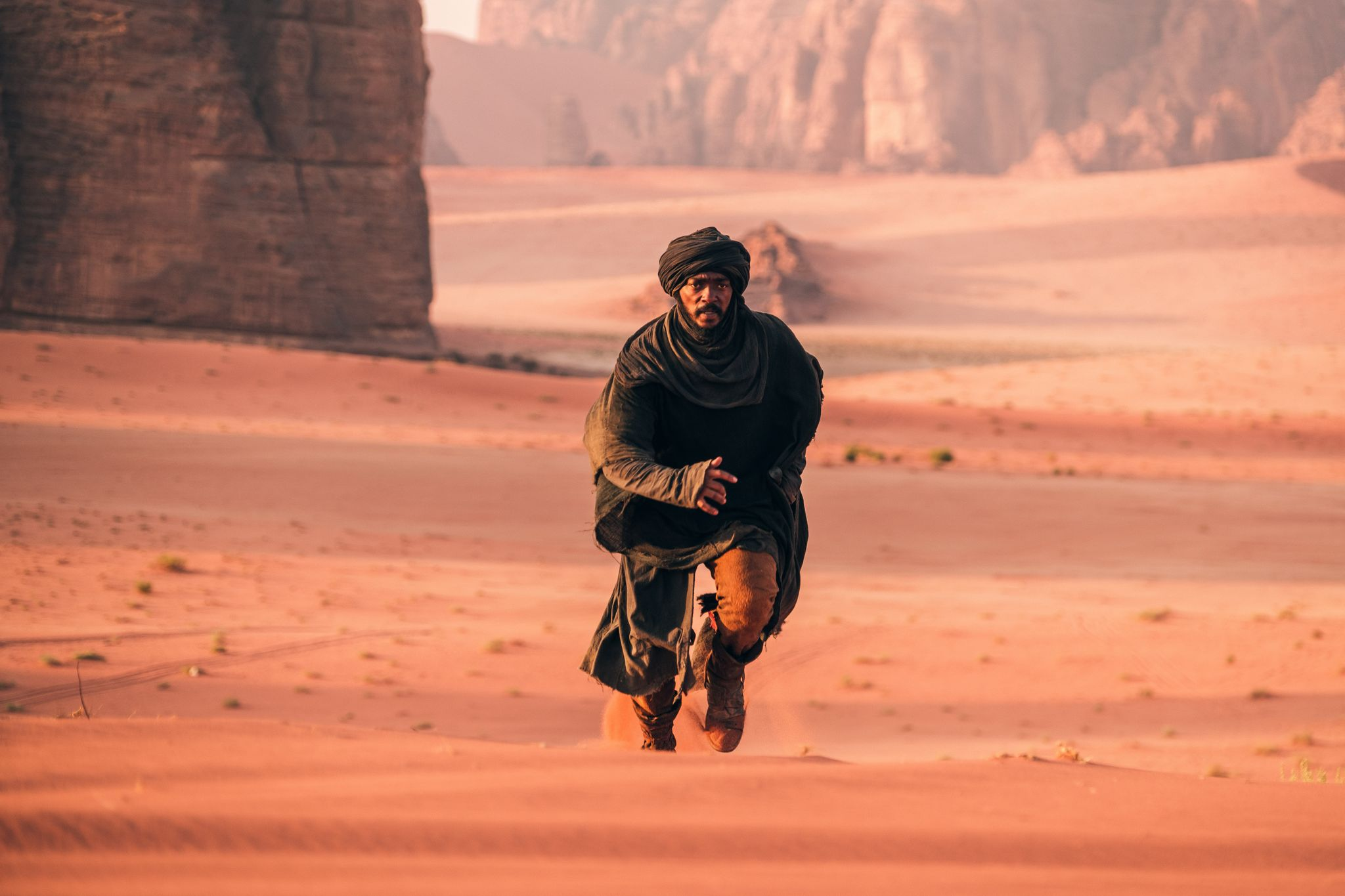
Even when the plot wavers, the film’s visual ambition remains steadfast. Wyatt skillfully captures the scale of the vast Saudi landscapes, which serve not just as a backdrop but as a character in themselves—vast and unforgiving, swallowing men whole and challenging heroes to rise. There are moments, especially in quieter scenes, where the film embraces mood and atmosphere, trusting its imagery to carry the weight of the story.
In the final act, “Desert Warrior” finally lives up to its title. The much-anticipated battle unfolds with grandeur—elephants charging, armies clashing, and the kind of widescreen spectacle that makes good use of its budget. It’s exhilarating, even if this payoff arrives a bit too late in the narrative.
What lingers after the credits roll is not frustration but curiosity. This film is not a fully realized epic; rather, it serves as a blueprint—a sign of what could emerge as Saudi cinema finds its footing on the world stage. Like many initial attempts, it is uneven and occasionally uncertain but undeniably bold.
In the simplest of terms, “Dessert Warrior” is a near-miss with flashes of greatness—worth watching for the spectacle, if not entirely for the story.
Final Grade: B –
“DESERT WARRIOR” is in theaters now.