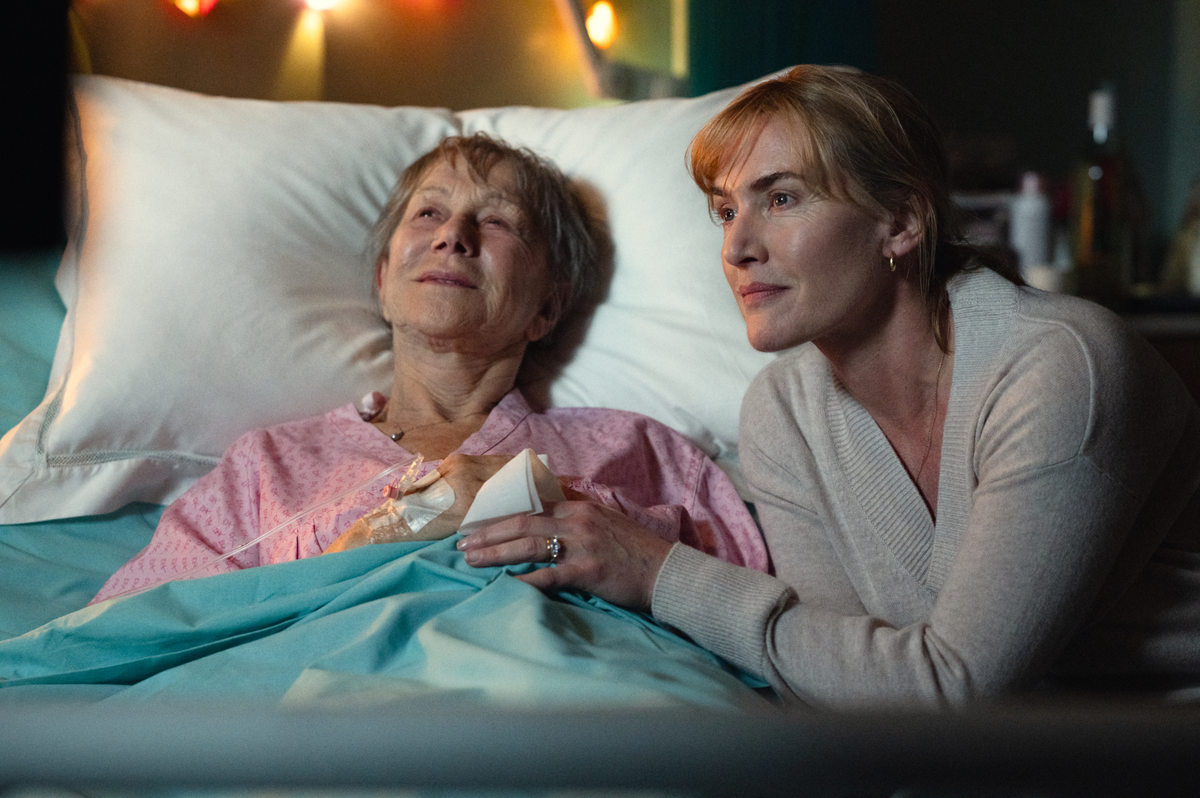
Seven-time Oscar nominee Kate Winslet dramatizes her real-life experience in her directorial debut, “Goodbye June,” from Netflix. Winslet’s son, Joe Anders, pens the film’s screenplay.
Two weeks before Christmas, June (Helen Mirren) collapses at her kitchen counter, the kettle still warming, the day already lost. At the hospital, the verdict is swift and unsparing: the cancer has advanced beyond intervention, and time has narrowed to a matter of days. Her son Connor (Johnny Flynn), still living at home with June and her perpetually sodden husband Bernie (Timothy Spall), gathers his three estranged sisters for what everyone understands will be a final reckoning disguised as a holiday reunion.
They arrive like incompatible elements forced into the same room. Julia (Kate Winslet), the flinty career achiever, brings efficiency and unresolved anger. Molly (Andrea Riseborough), an eco-conscious mother wound tight with moral urgency, carries resentment like a second spine. Helen (Toni Collette), heavily pregnant and steeped in yoga-speak and incense, floats in with an air of performative serenity. That these women barely recognize one another anymore is the film’s emotional premise—and its central risk.
“Goodbye June” begins awkwardly, even irritably, with director Kate Winslet testing comic relief where gravity should rule. An early phone call interrupting a holistic dance class, capped by an absurd anecdote about a naked fatal slip, lands with a thud. A prolonged hospital scene, punctuated by the nervous clicking of a doctor’s pen, stretches tension without earning insight.
Some viewers may wonder, in these moments, why a story this terminal keeps reaching for jokes that only blunt its edge. Thankfully, the film steadies as it goes. The humor softens into something human rather than desperate—most winningly through Molly’s well-meaning husband Jerry, whose giddy pride in sourcing an elaborate Christmas roast feels like the kind of misplaced joy families cling to when nothing else is fixable.
Sentimentality is largely resisted. There’s no syrupy yuletide glow, just fluorescent corridors and the quiet indignity of decline. The film finds its pulse in performance. Mirren, confined to a hospital bed beneath heavy makeup, works in small, lucid gestures and dry observations, reminding us of the authority that can exist even in retreat.
Collette commits fully but remains saddled with a role written too close to caricature. Flynn brings nervous texture and lived-in fragility to Connor, while Winslet and Riseborough deliver the film’s finest stretch: a rigorously staged, seven-minute corridor conversation, shared chocolate bar in hand, in which bitterness, guilt, and responsibility are unpacked without adornment. It’s plainspoken, emotionally precise, and devastatingly honest.
As a directorial debut, “Goodbye June” is uneven but sincere—a restrained Christmas family drama that earns its tears through actors, not manipulation. When it trusts silence and performance, it works. When it strains for levity, it falters.
Like the season it’s set in, “Goodbye June” is most affecting when it remembers that reflection, not decoration, is the point.
Final Grade: B
“Goodbye June” is in limited theaters and available to stream on Netflix on December 24th.