Director Francis Lawrence pivots from the world of “The Hunger Games” to the claustrophobic confines of a lonely road in his latest book adaptation, “The Long Walk,” from Lionsgate. JT Mollner has written the screenplay, which is based on the 1979 novel of the same name by Richard Bachman, a pseudonym for Stephen King.
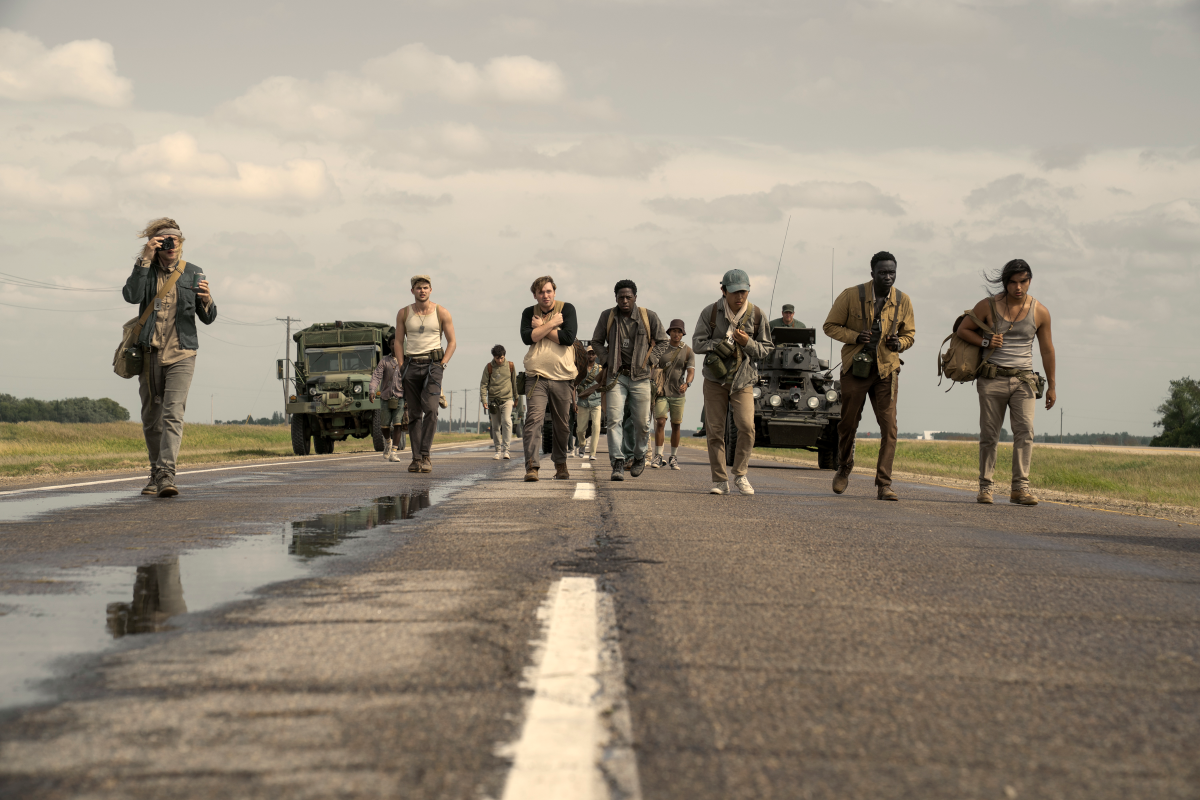
Set in an alternate, dystopian version of the United States, the plot revolves around the Long Walk, an annual contest in which 100 young men walk continuously along a designated route, presumably Route 1. Participants must maintain a minimum pace of 4 miles per hour (6.4 km/h). Soldiers monitor their progress and issue verbal warnings if they fall below this speed for 30 seconds.
The central walkers in the film are Ray Garraty (Cooper Hoffman), Peter McVries (David Jonsson), Stebbins (Garrett Wareing), Barkovitch (Charlie Plummer), Hank (Ben Wang), and Arthur (Tut Nyuot). The film’s very essence relies on its young cast, who carry the weight with a maturity beyond their years. Cooper Hoffman’s portrayal of Ray Garraty is a revelation; he gives us a protagonist who isn’t merely surviving but is actively searching for meaning in the absurd.
While Jonsson continues to add to an already impressive resume, and in a less crowded year, he could be in awards talks. Hoffman, along with Ben Wang and Tut Nyuot, forms the heart of the “four musketeers.” Their camaraderie and raw emotional exchanges draw us into the punishing intimacy of the road. Sitting in the theater, I was reminded of my time in basic training.
The legendary Mark Hamill makes for a great villain as the Major. Hamill brings a masterful yet understated menace that contrasts sharply with his heroic legacy. This performance anchors the film with a palpable, unsettling dread and opens the door to more villainous roles in the future.
“The Long Walk” doesn’t hold back on the violence, and it adds to the terrifying psychology behind a cruel contest. When the inevitable, shocking moments of violence occur, they land with brutal efficiency, reminding us of the stakes without resorting to gratuitousness.
Lawrence’s direction is a masterclass in controlled suspense, demonstrating his ability to create a dystopian world not through CGI but through the human anxieties etched on his actors’ faces. The decision to scale back makes for a hauntingly successful film. I was generally invested in all of the key players and even got choked up a few times.
“The Long Walk” is a stark, resonant piece of filmmaking. It may not provide the easy entertainment of a blockbuster. Still, it is a necessary watch—a confrontational piece of cinema that explores the brutal logic of survival with unsettling and profoundly moving grace.
This film lingers with you long after the credits roll, making it a cinematic journey well worth the arduous path.
Final Grade: A
“The Long Walk” opens in theaters on Thursday, September 11th.